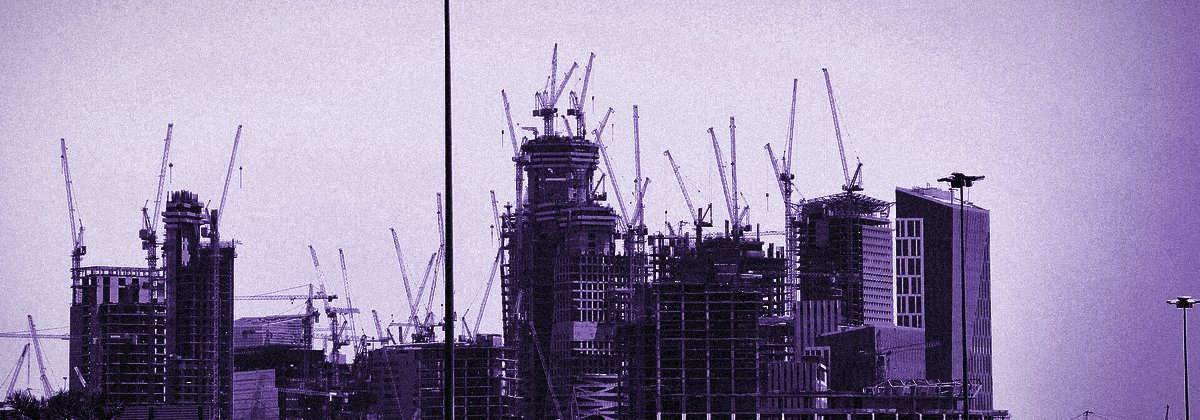
The headline in the Saudi Central Bank’s August lending data is its refusal to move. Credit to the private sector and non-financial government entities reached SR3.57 trillion, 7 percent higher than a year earlier, according to figures reported by Argaam, and the growth rate has sat at roughly that level all year after starting January at 10 percent. Underneath the flat line, the book is rotating. Lending to non-financial government entities grew 18 percent to SR277 billion, three times the pace of the private sector’s 6 percent. The borrowers pulling hardest on Saudi bank balance sheets are the entities building the Kingdom’s infrastructure.
The sector detail makes the rotation legible. Arab News, reading the same bulletin, put credit to utilities up 23.4 percent year on year at SR258.19 billion, and credit to healthcare up 29.8 percent at SR34.46 billion. Both are program sectors: power generation, water and transmission on one side, hospital capacity on the other. The pattern matches what the project market printed only yesterday, when the Rabigh 2 expansion closed SR9.69 billion of financing on a tenor near 34 years with three Saudi banks in the lending group. Deals of that shape, repeated across a procurement pipeline, are how a utilities book grows a quarter in a year.
The private-sector line deserves a more careful reading than its 6 percent suggests. It still holds 92.2 percent of total credit, so the book remains overwhelmingly commercial. But its growth is now the slower component, and some of what the state-adjacent book absorbs, contractor finance, supplier credit, equipment leasing, would once have been classified there. The boundary between the two lines is partly an accounting one. What is not ambiguous is the direction: the fastest-growing credit in the Kingdom is tied to the build, not to trade.
The funding side of the balance sheet is where the cost of this shows. The bulletin recorded time and savings deposits rising to SR1.4 trillion while demand deposits fell 5.2 percent to SR1.42 trillion. With the policy rate at 4.50 percent, depositors are being paid to lock money up, and they are taking the offer. For banks, that is the right funding to hold against long assets, a 34-year project loan cannot sit on overnight money, but it is more expensive than the free deposits it replaces. Saudi lenders have spent the year supplementing it in the capital markets, with Al Rajhi and Arab National Bank among those issuing internationally.
The margin arithmetic lands this month, when third-quarter results begin. Loan books growing 7 percent should lift income; funding that has termed out and repriced will take some of it back. The mix question runs deeper than one quarter: lending linked to government entities typically carries tighter spreads in exchange for lower risk, so a book tilting that way trades margin for volume and stability. Whether shareholders read that as prudence or dilution will show in how the banks guide on 2027.
The September bulletin will indicate whether the deposit rotation is still running, and the debt office’s October issuance will show what the sovereign curve pays against bank paper. The number to hold from August is SR277 billion: the state-adjacent credit line, growing at 18 percent. If that pace survives the next two quarters, the Kingdom’s banks will have become, in effect, the second balance sheet of the infrastructure program, and the pricing of everything else they do will adjust around that role.