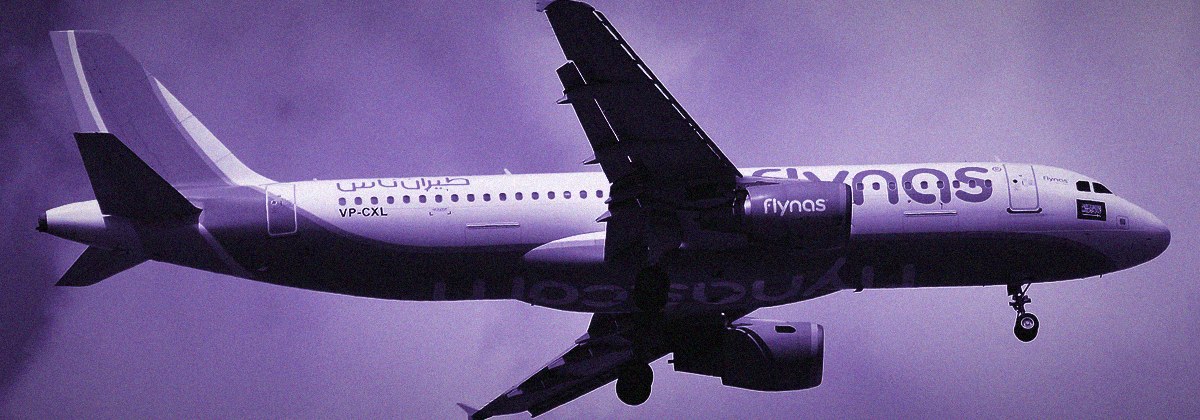
A flynas Airbus out of King Khalid International landed at Aleppo on Saturday afternoon, the first direct commercial link between Riyadh and Syria's second city since 2012. The schedule is deliberately modest, two rotations a week, Wednesdays and Saturdays, out at noon and back by early evening. The commitment behind it is not modest at all. Aleppo is the second Syrian city flynas has opened in fourteen months, the carrier has ordered aircraft against the expansion, and it has told the market it intends to stand up a joint-venture airline inside Syria before the end of the year.
The network arithmetic tells the story more precisely than the inaugural photographs. Since returning to Damascus in June 2025, flynas has built the Syrian capital up to 24 weekly frequencies from the Kingdom: fourteen from Riyadh, seven from Jeddah, three from Dammam. That is no longer a symbolic service; it is a schedule sized for steady, paying traffic. Aleppo starts at two weekly flights with introductory fares of 1,110 riyals outbound and 823 riyals on the return, and the gap between those two numbers is itself information. The carrier is pricing the Riyadh-originating passenger, the Syrian resident of the Kingdom flying home, above the Aleppo-originating one, which is where the purchasing power sits.
Aleppo was Syria's commercial and industrial capital before the war, and its reconstruction is the heaviest lift in the country's recovery. The city's airport reopened to three international carriers on the same day: flynas from Riyadh, SunExpress from Antalya, and Germany's LEAV Aviation from Düsseldorf. Omar Hosari, who heads Syria's General Authority of Civil Aviation and Air Transport, called the simultaneous arrivals evidence of growing confidence among international carriers. For the Saudi carrier the route logic is concrete rather than sentimental: hundreds of thousands of Syrians live and work in the Kingdom, family and business traffic between the two economies has been routing through Damascus or third countries, and Umrah travel from northern Syria has had no direct corridor at all.
The Joint Venture Is the Real Commitment
A twice-weekly rotation is a probe; low-cost carriers open thin routes cheaply and withdraw from them just as cheaply. The harder signal came in July, when flynas added 25 Airbus aircraft to its order book with its Syrian ambitions explicitly attached, and confirmed plans for a joint-venture airline in Syria beginning in the fourth quarter of 2026. A joint venture bases aircraft, crews and maintenance inside the country. It converts a foreign carrier's optionality into fixed exposure, and it positions flynas ahead of Gulf competitors in a market where flydubai has only just returned to Aleppo itself.
The aviation file sits inside a wider Saudi position on Syria. The Crown Prince spoke with President Ahmad Al-Sharaa by telephone on Friday, a call the Saudi Press Agency reported as an affirmation of the Kingdom's support for Syria's security and stability. Riyadh has backed Syria's economic reopening since 2025, and air connectivity is the layer of that policy ordinary travelers actually touch. A reconstruction economy runs on contractors, suppliers and remittance visits before it runs on tourism, and all three move by air when they can.
What to watch is frequency, not route count. If the Wednesday and Saturday rotations fill through August, an increase ahead of the Umrah season would follow the same pattern Damascus did, and a Jeddah link to Aleppo becomes the natural next line in the timetable. The joint venture's launch window in the fourth quarter is the date that converts a schedule into a stake.