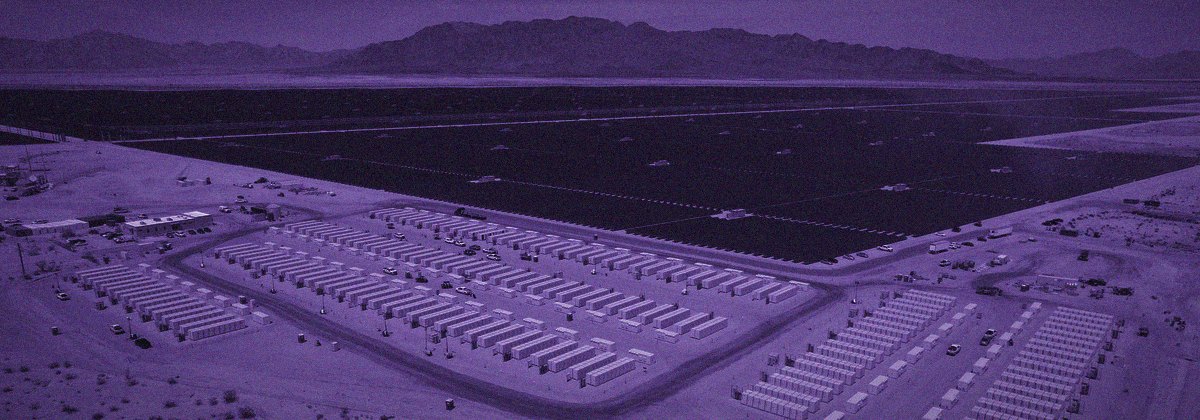
Start with the tariff. The solar agreements Saudi developers signed for Syria this week, valued at nearly one billion dollars, price electricity from three US cents per kilowatt-hour in a country whose public grid has managed only a few hours of supply a day for much of the past decade. Prices in that range are routine in Saudi procurement rounds and rare almost everywhere else. Writing one into a Syrian contract is a statement that the Kingdom’s way of buying solar power, and not only its capital, can travel.
The package, signed in Damascus under the supervision of the Ministry of Energy, commits Mohammed Ahmed Al-Harfi Co., a private Saudi developer, to build 760 megawatts of solar generation and 1,077 megawatt-hours of battery storage at Widyan Al-Rabie in Rif Dimashq. Three power purchase agreements with the Syrian Electricity Co. carry terms of 20 to 25 years. Two technical cooperation agreements sit alongside them: one with the Saudi Electricity Project Development Co. for specialized engineering services, and one with Siemens Energy of Germany covering substations, power generation and storage systems. Saudi Deputy Minister of Energy Faisal Al-Duaij put the combined value at nearly one billion dollars. Syrian officials describe implementation within four to five years, with an effort to finish in three, supplying Damascus and its countryside first and Aleppo in a later phase.
The structure will be familiar to anyone who has watched the Kingdom’s own renewables program: long-dated offtake contracts, aggressively priced generation, and storage procured together with the panels rather than bolted on afterward. That formula turned Saudi solar rounds into some of the cheapest electricity ever contracted anywhere. Reconstruction economics usually run in the opposite direction. Damaged grids, weak counterparties and political risk produce expensive power or no investment at all. A three cent starting tariff on a horizon of up to 25 years implies financing on terms Syria has not seen in more than a decade, and a developer willing to stand behind them.
Batteries Instead of Wires
The storage number carries its own information. At 1,077 megawatt-hours, the batteries are larger in energy terms than the nameplate of the panels beside them, a heavier ratio than Saudi domestic projects carry. At home, storage smooths the evening peak of an otherwise robust grid. In Syria it substitutes for the grid itself, holding midday generation for the hours when a fragile transmission network would otherwise leave the capital dark. The design concedes something true about reconstruction: generation can be rebuilt faster than the wires that carry it.
Who signed is as deliberate as what was signed. The developer is a private contractor rather than ACWA Power or a Public Investment Fund vehicle, with the ministry supervising and Siemens anchoring technical standards. That arrangement keeps sovereign exposure limited while leaving no doubt about state direction. If the projects perform, larger Saudi names arrive in Damascus with a proven template. If they struggle, the setback is commercial rather than political.
The strategic logic is sequencing. Electricity is the first layer of any reconstruction; factories, cold chains, water treatment and housing all wait on it. The firms that supply the first reliable kilowatt-hours to a recovering economy tend to shape the standards, supply chains and commercial relationships that follow. For the Kingdom, these agreements convert several years of diplomatic re-engagement with Damascus into physical assets on Syrian ground, and open an external market for the engineering and procurement capacity the domestic program has spent a decade building.
Three markers will show whether the ambition holds: financial close and mobilization at Widyan Al-Rabie, the pace at which the Aleppo phase firms up, and the identity of the next Saudi signature in Damascus. One contract is a bet. A second is a market.