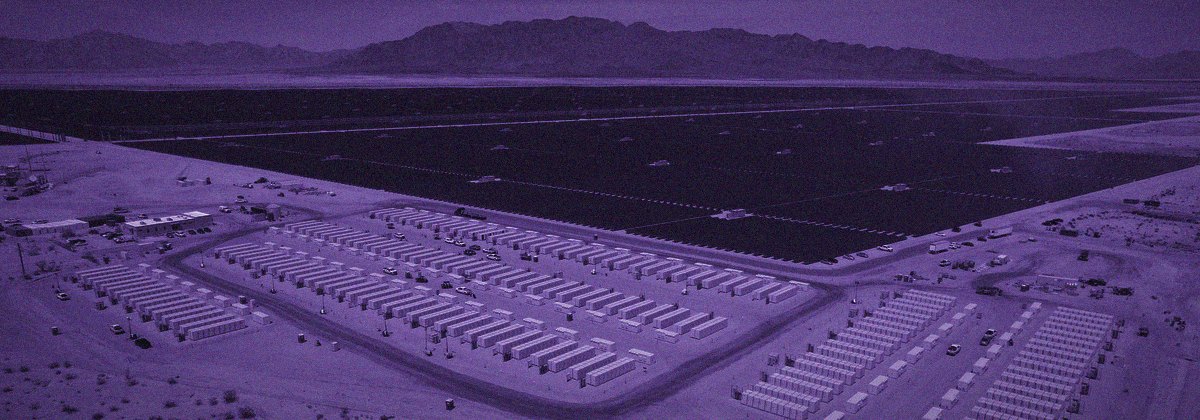
The Kingdom’s electricity buyer spent SR4.35 billion ($1.16 billion) last week on a commodity that does not generate a single watt: time. The Saudi Power Procurement Company signed storage service agreements in Riyadh on Thursday for four battery projects of 500 megawatts each, every one built to hold four hours of charge, 8,000 megawatt-hours in all. Energy Minister Prince Abdulaziz bin Salman attended the signing. The purchase is best read literally: the grid is buying the hours between when solar power is made and when Saudi households want it.
The confirmed terms: two projects, Al Muwayh and Haden, sit in the Makkah region, with Al Kahafa in Hail and Al Khushaybi in Qassim. A consortium of Saudi Energy Company, ACWA Power and Al Sharif Contracting took the first three; ENGIE and Haji Abdullah Alireza and Co. took the fourth. All four will be delivered on build-own-operate terms, with the procurement company buying the storage as a service. The projects support the national target of generating around half of the Kingdom’s electricity from renewables by 2030.
Four hours is the number that matters. Solar output in the Kingdom peaks at midday; demand peaks in the evening, when air conditioning meets the end of the working day. A four-hour battery moves the midday surplus into that evening ramp, which is the difference between solar as a fuel saver and solar as dependable capacity. Without storage, every new solar park deepens a midday glut the grid cannot use; with it, the same park displaces gas turbines at the hour they earn their keep. Storage capacity, not panel capacity, is now the binding constraint on how fast the renewables share can rise.
The contract structure is the familiar Saudi playbook applied to a new asset class. The storage service agreement mirrors the power purchase agreements that built the Kingdom’s solar fleet: developers finance, build, own and operate the plant, and the state buyer commits to pay for capacity over the contract’s life. That model produced some of the world’s lowest solar tariffs by making global developers compete for bankable, dollar-denominated cash flows. Pointing the same auction machinery at batteries converts storage from a capital project on the state’s books into an operating cost, and prices it through competition rather than estimation.
The cadence says this is a program, not a pilot. These four projects follow a second group of six, totaling 3,000 megawatts, announced in June. Ten projects and 5,000 megawatts of storage procurement in a single summer is a standing pipeline, and the geography reinforces the point: Makkah, Hail and Qassim are load centers and grid nodes, not a single showcase site. The consortium lists carry their own signal, pairing ACWA Power and ENGIE with domestic contractors Al Sharif and Haji Abdullah Alireza, which spreads the construction economy of the buildout into Saudi firms from the first group onward.
The market treated the news as routine, which is itself informative. ACWA Power closed Sunday’s session, the first after the signing, up 1.18 percent at SR188.60. Storage service agreements are annuities: steady, contracted, modest-margin cash flows rather than windfalls. A sector that moves one percent on a billion-dollar award is a sector that has priced this pipeline as ordinary business, and ordinary is what infrastructure programs need to be to reach 2030 volumes.
The details to watch are the ones the announcement left out: the tariffs the auctions produced, the financial close dates, and the commissioning schedule that will show when the first stored electron reaches an evening peak. Beyond that sits the structural question of whether future renewables tenders arrive paired with storage from the outset. When they do, the Kingdom will have stopped buying solar power and started buying solar evenings.