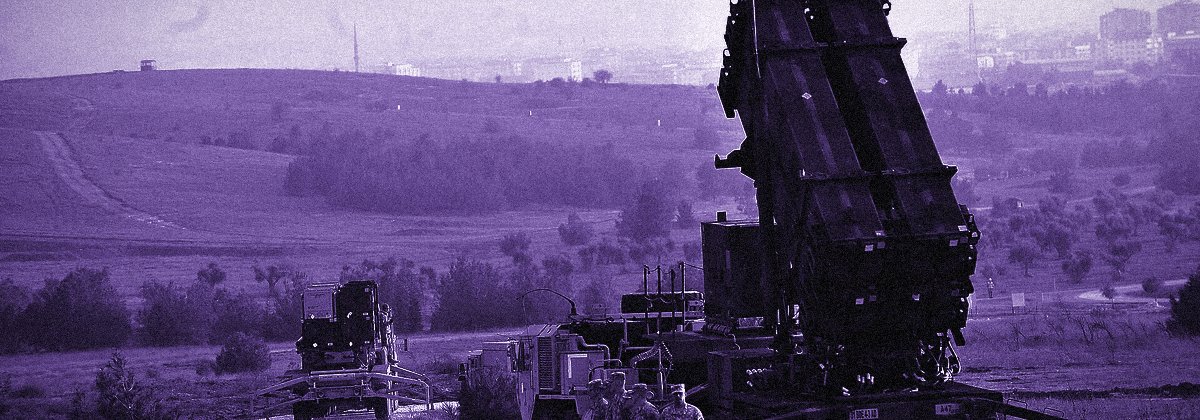
For three weeks the campaign against Saudi oil has come from the south. Houthi missiles found tankers off Jizan, then the Jizan refinery, then the approaches to Yanbu. On Monday the defense ministry announced a different bearing entirely: several drones, launched from Iraqi territory, intercepted and destroyed on their way to oil facilities in the Eastern Province and the Riyadh region. Maj. Gen. Turki al-Maliki attributed the launches to Iran-backed militias operating from Iraq. Nothing reached its target. The bearing is the news.
The confirmed record is short. No group has claimed the drones, and Riyadh named none. The foreign ministry condemned the attacks in the strongest terms, asserted what al-Maliki called the kingdom's "legitimate right to defend its security, people and vital infrastructure," reserved the right to respond to the sources of the attacks "at the appropriate time and place," and called on the Iraqi government to ensure its territory is not used as a launchpad against the kingdom. No casualties or damage were reported. Everything past that point is inference, but the inference is not difficult.
A Pincer on the Same Pipe
Read the target list against the kingdom's wartime plumbing. With Hormuz closed since spring, Saudi export crude originates at Eastern Province fields, crosses the peninsula through the East-West pipeline, and loads at Yanbu. The southern campaign has worked the delivery end of that system: the ships, the terminal approaches, the refinery nearest Yemen. The Eastern Province is the intake, and it has been quiet since Iran's own missile salvos ended in the spring. Monday's drones were aimed at that quiet end. Whether or not the volley was coordinated with Sanaa, the effect is a pincer on the same pipe: pressure at the coast where the crude leaves, now a probe at the fields where it starts.
Outside the Letter of the Formula
The timing carries as much information as the geography. The United States has not struck Iran since Friday. Iran has suspended its own retaliation. Pakistan and Qatar are carrying messages, Oman ran technical talks on Hormuz transit through the weekend, and Washington's UN ambassador described the lull as giving negotiations room. Into that lull came an attack from a direction the American formula never named. Trump's warning last week specified that the next Houthi attack on Saudi Arabia would be treated as an act of Iran. Saturday's strike on Aramco tested whether the formula would execute, and it did not. Monday's drones test its coverage: different militias, different country, outside the letter of the sentence. Whoever ordered the launches located the seam precisely. The pressure on Saudi Arabia continues, no named tripwire is touched, and Tehran's own launchers stay cold while its negotiators talk.
Riyadh's phrasing did its own work. "Sources of the attacks" is the doctrine applied all month in Yemen, where coalition and Yemeni government aircraft struck launch sites in Marib and al-Jawf within hours of the Aramco attack. Applying it in Iraq would mean operating on the territory of a neighbor Riyadh has spent a decade steadying relations with, and whose government it needs functional rather than embarrassed. The demand on Baghdad is the cheaper instrument: it converts the problem into an Iraqi sovereignty obligation, puts the militias' patrons on notice, and preserves every option without exercising any. That matches the kingdom's conduct throughout this war: intercept first, answer where the answer is containable, and keep the response ledger deliberately shorter than the attack ledger.
Three Readings
Whether launches from Iraq recur is the first: one volley is a probe, a second is a front. Whether Washington extends its formula to cover Iraqi launches, or leaves the seam open while the talks run, is the second. The third belongs to Baghdad, whose answer to Riyadh's demand will reveal how much control it has over the launchers on its soil, and how much it is prepared to admit it lacks.