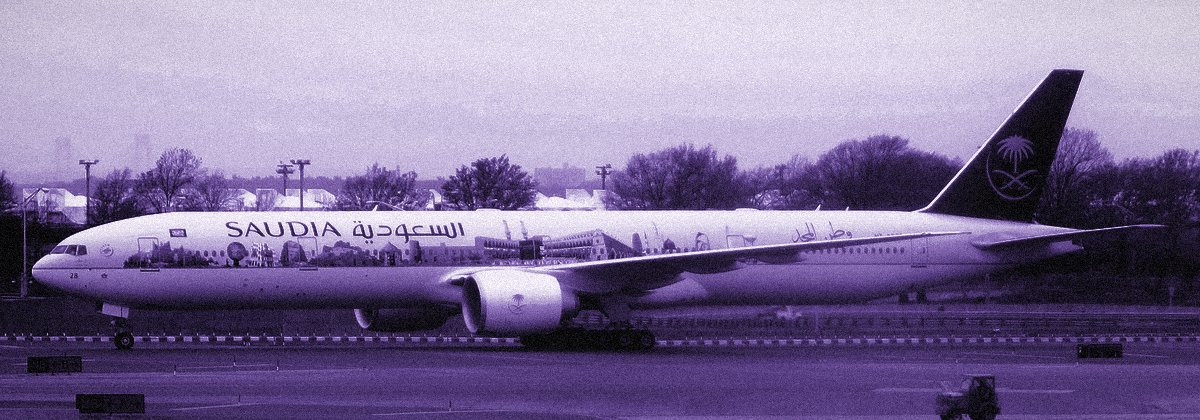
Airlines win punctuality rankings in quiet months all the time. Saudia won July. Cirium, the aviation analytics firm whose monthly report is the industry standard, placed the national carrier first in the world for on-time performance last month: 87.24 percent of 16,406 flights arrived on schedule. It is Saudia’s third consecutive month at the top of the global table, and it came in the weeks when the Saudi system is under the most strain it faces all year, with summer holiday traffic at full volume and Umrah flows layered on top.
The facts are narrow and verifiable. Cirium counts a flight as on time when it arrives within fifteen minutes of schedule, and it measures actual gate arrivals, not airline claims. A rate above 87 percent across sixteen thousand flights in a peak month is rare; sustaining first place through May, June and July is rarer. The General Authority of Civil Aviation’s own scorecard points the same direction: in June, Saudia recorded the fewest passenger complaints among Saudi carriers, 39 per 100,000 travelers, and resolved 89 percent of them on time.
What the streak measures is not comfort or network reach but process: how fast aircraft turn between flights, how maintenance is scheduled, how crews are positioned, how much slack the timetable carries. Those disciplines are invisible when they work and expensive when they fail. A delayed morning departure cascades through an airline’s whole day; at scale, chronic delay becomes a tax on every seat sold. Ibrahim Al-Omar, Saudia Group’s director general, framed the ambition plainly: “We aim to make operational punctuality a consistent standard in our guests’ travel experience, not just a temporary achievement.”
Reliability as Strategy
The timing gives the number its weight. The Kingdom’s aviation strategy calls for 330 million passengers a year and 250 destinations by 2030, roughly triple the traffic the system handled when the target was set. Riyadh Air is adding routes, King Salman International Airport is under construction, and Saudia itself is taking new aircraft. Growth of that order is unforgiving of operational weakness: every additional bank of flights multiplies the ways a schedule can unravel. An airline that can hold 87 percent in July has margin to grow into; one that cannot ends up buying growth at the cost of its own timetable.
There is also a competitive logic. The Gulf’s established super-connectors compete on network breadth and product. Those are decade-long games, and Saudia is still building its position in both. Punctuality is the dimension where a disciplined operator can lead now, and it is the one that matters most to the passengers the Kingdom most wants to win: pilgrims on fixed itineraries, business travelers pricing their hours, and connecting passengers deciding whether Jeddah and Riyadh are hubs they can trust with a tight transfer. Reliability is a reputation built monthly, which is why a rolling first place matters more than any single result.
The regulator’s role deserves notice. GACA publishes carrier-by-carrier complaint tables every month, which turns service quality from an internal metric into a public league standing. The alignment is deliberate: the operator chases the ranking, the regulator publishes it, and the strategy needs both to hold as capacity scales.
The next tests are already scheduled. August brings the return wave of summer travel, then the winter timetable change, and behind both sits the steady arrival of new aircraft and routes that the 2030 targets require. The number to watch is not whether Saudia stays first, which month to month is partly noise, but whether the on-time rate holds in the mid-80s as the operation gets bigger. That is the difference between a good quarter and an operating culture.