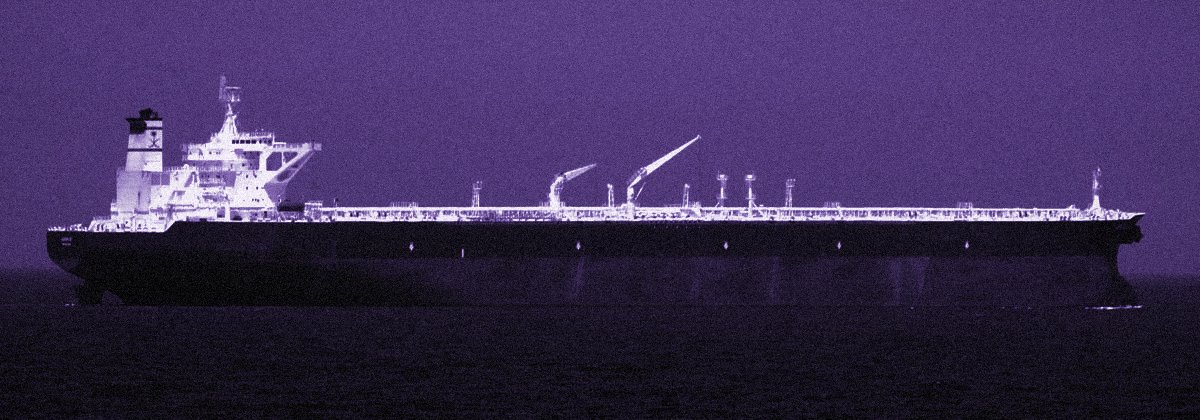
Whether the Strait of Hormuz reopens is no longer being decided in negotiations. It is being decided transit by transit, and Friday produced both kinds of evidence at once. The Revolutionary Guard said it struck and halted two tankers moving through the strait's southern corridor under American air escort, and that four more turned back. Reuters shipping data showed two very large crude carriers exiting the strait the same day. The market read both signals together and moved about one percent.
The confirmed record is thinner than the claims. The Guard's statement, carried by Iranian state media, said the two tankers had been misled by US Central Command into what it called an unsafe and illegal route along the Omani coast, that one caught fire, and that shipping companies should disregard American operational directives. No vessel names have been published, no distress traffic has surfaced publicly, and Washington has not confirmed either an escort operation or an attack on one. What is verifiable is the outcome data: tankers did exit the strait on Friday, most of the strait's remaining traffic moves with transponders off, and Brent finished the week near 90 dollars, up 1.3 percent on the day and roughly 24 percent for July, its strongest month since March.
A Closure Iran Can Meter
The claim's structure says more than its details. A strait that is fully closed invites exactly the convoy system Washington has weighed since spring; a strait that is selectively open preserves leverage without forcing that confrontation. Striking hulls that follow Central Command's corridor while supertankers exit on Tehran's terms is a message aimed at shipowners and underwriters rather than at navies: passage exists, but Iran decides whose. Whether Friday's fire happened as described matters less than the effect, because insurers price claims they cannot rule out.
Riyadh's File Is a Different File
The Kingdom's own barrels do not ride on this corridor. Exports have moved through the East-West pipeline to Yanbu since the spring, inside a ceiling near 7 million barrels a day, which is why this week's flash GDP estimate recorded the closure as a 24.7 percent fall in oil activity. The maritime coalition Riyadh founded last week is scoped to the Red Sea, Bab al-Mandab and the Gulf of Aden, deliberately not to Hormuz. The division of labor holds: the Kingdom builds institutions where its own coastline runs, and the strait remains Washington's file. Nothing in Friday's exchange moved that boundary, which is the point of having drawn it.
An analyst at SEB Research described the shift under way in one line: the market has stopped trading the war and started trading the shipping data. For the Kingdom that framing cuts in two directions. Every verified transit erodes the premium that has kept Brent above 90 dollars, which is revenue. Every verified transit also brings the reopening closer, which restores volumes, the Kingdom's and everyone else's, along with the market structure the closure suspended. The pipeline ceiling caps how many barrels the Kingdom can sell into the elevated price, which is why Riyadh can afford patience on the corridor question without being indifferent to it.
The next fixed date is not maritime. Kataib Hezbollah's deadline to Baghdad expires on 6 August, and the pattern of recent weeks is that pressure blocked on one front resurfaces on another. Between now and then the specifics worth watching are narrow: whether Central Command confirms or corrects the escort account, whether a named vessel or an insurer surfaces a claim, and whether the transit count, the series the market now actually trades, rises for a second week.